
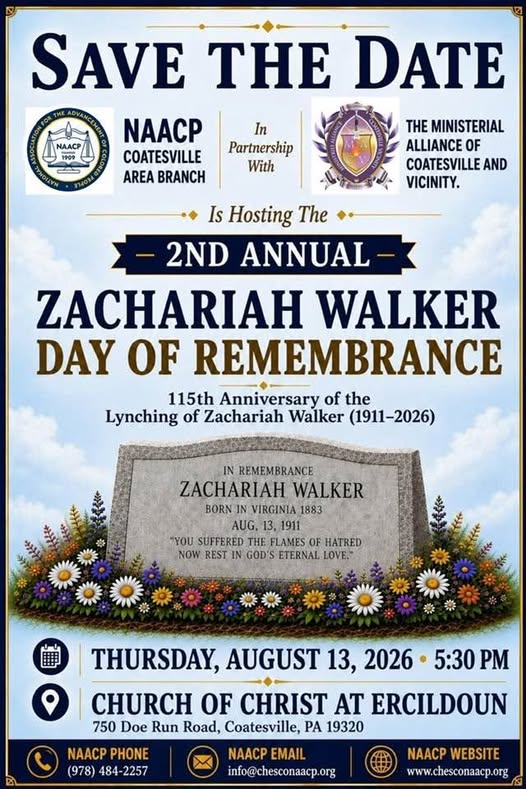
Zachariah Walker was lynched in Coatesville in 1911. In 2025 we helped host the first annual Zachariah Walker Day of Remembrance (link at the bottom), where we came together as a community to continue to tell the story and to continue to grow together.
We hope to continue to celebrate Zachariah Walker each August.
Zachariah Walker Events

Zachariah Walker’s Story
Below is the story of Zachariah Walker’s lynching, produced by two professors of history emeritus for the first Zachariah Walker Memorial of Remembrance in 2025. We’re reproducing it here for accessibility. It may be considered graphic in places, but it’s real history, and we believe it’s important to remember.
Commemoration: The Lynching of Zachariah Walker
Historians have generally treated lynching as a peculiarly Southern phenomenon, but on
Sunday evening August 13, 1911, one of the worst spectacle lynchings in American history
occurred in Coatesville, a mid-sized Pennsylvania steel town. The burning alive of Zachariah
Walker as several thousand spectators looked on demonstrated the worsening nature of race
relations in the North during the era of the Great Migration of southern Blacks to northern towns
and cities in the early 1900s.
Moreover, the incident received national and international attention, and it dramatized the
potential for racial violence in Pennsylvania and across the country. The Coatesville lynching
also mobilized the newly formed NAACP to launch a nationwide anti-lynching crusade.
Reformer John Jay Chapman termed the entire episode “one of the most dreadful crimes in
history” and an “American tragedy.”
Pennsylvania has a long history of racial conflict, chiefly in the form of race riots and efforts
to deny suffrage. In the late nineteenth and early twentieth century there were eight recorded
lynchings in the Commonwealth. By any standard of measurement, the Coatesville lynching was
the most significant and had the most far-reaching consequences.

Coatesville, PA, c. 1911. Source: Chester County History Center, West Chester, PA
Coatesville itself was a prosperous steel town located along the Brandywine Creek some
thirty miles west of Philadelphia. As the industry grew the small borough tripled in size to
nearly 12,000 inhabitants by the summer of 1911. The largest influx of newcomers was from
southern and eastern Europe, and African Americans, including Zachariah Walker, who had only
recently arrived from rural Virginia and secured employment in the Worth Brothers mill.
Tensions between natives and newcomers ran high that season. We will never know
exactly what took place on Saturday evening, August 12. What we do know is that as he walked
home alone, Walker became involved in a scuffle with Edgar Rice, a former borough policeman
now working as a security guard at the mill site. When Rice tried to arrest Walker for public
drunkenness, the two scuffled, Walker shot the guard, and then fled the scene. (Given the
guard’s questionable jurisdiction off company property, Walker may have been acting in self-
defense.) Rice stumbled to a nearby storefront where he died of his injuries. Within an hour a posse formed and set out to apprehend Walker, who had vanished into the countryside south of
Coatesville.
By mid-morning Sunday a group of men found Walker hiding in an orchard. As they
approached him Walker allegedly tried to take his own life rather than be captured. It is more
plausible that a member of the posse shot Walker, who fell from a tree with a severe head
wound. Someone said, “Let’s lynching him here,” but cooler heads prevailed, and Walker was
transported back to the Coatesville hospital, where surgery was performed to repair his jaw.
Around twilight, a crowd estimated at more than two thousand marched on the hospital, the
police guard stood aside, and the leaders seized Walker, still shackled to the bed frame, and
carried him from the hospital out Strode Avenue. Just off the road a large bonfire was set, and
the mob watched in morbid fascination as Walker was thrown atop the pyre. Three times he
crawled off, only to be thrown back in the blaze. The last time Walker’s foot was cut off and a
rope tied around the victim to hold him in the inferno. His last spoken words were, “Don’t give
me no crooked death because I’m not white.”
When the deed was done, onlookers waited hours for the ashes to cool so they could
retrieve souvenirs. By all accounts the most excited culprits were teenage boys closest to the fire.
No one stood against the mob.

Zachariah Walker’s Remains, August 14, 1911. Source: Chester County History Center, West
Chester, PA
For two weeks, state police patrolled the streets to prevent further racial unrest and quell
rumors of reprisals. National criticism was scathing, with the likes of former president Theodore
Roosevelt, and civil rights leaders T. Thomas Fortune and Ida Wells-Barnett denouncing the
residents and police for their inaction. The NAACP’s W.E.B. Du Bois wrote scornfully of “that
quiet Sabbath evening,” when a large number of people left church services to follow the mob.
Religious periodicals condemned a conspiracy of silence that stymied efforts to bring the alleged
perpetrators to justice.
Despite strong community opposition, pressure from the state government resulted in the
indictment of a dozen men and teenage boys for their roles in Zachariah Walker’s death. In the
end, all were found not guilty and the Commonwealth abandoned further prosecutions. One
constructive outcome was a NAACP-sponsored rally in New York to raise funds in support of a
national anti-lynching campaign. Although the Commonwealth threatened to revoke
Coatesville’s municipal charter, no further action was taken against the community or those
responsible for Walker’s abduction and death. The Walker lynching did, however, mobilize a
movement in Pennsylvania for a state anti-lynching law. First proposed in the General Assembly
in 1913, it took ten years for the measure to gain enough support to become a law that made
participation in a lynching a felony.

Local residents standing near the site of Zachariah Walker’s lynching, August 14, 1911 Source:
Chester County History Center, West Chester, PA
Lynchings were often underreported, and attempted lynchings, including two later incidents
in Coatesville, often have been ignored in the history of racial violence. In 1938, as rumors
circulated of a possible lynching, local Blacks organized themselves into an armed militia to
prevent further violence. In 1911, police chief Charles Umsted was indicted for involuntaery
manslaughter for his failure to the stop the lynching. This time, Coatesville police chief Ralph
Williams courageously used his authority to prevent vigilante violence. It should be noted that
both Zachariah Walker and Edgar Rice, their families, and the community were traumatized in
the 1911 incident. The lynch mob not only prevented Walker from receiving a trial; it also
prevents us today from fully understanding what actually took place between Rice and Walker.
The memory of Zachariah Walker’s lynching remains controversial, another reminder of the
history and gruesome legacy of mob violence and racial intimidation in Pennsylvania and the
United States.
Dennis B. Downey, Ph.D., is Professor of History Emeritus at Millersville University.
Charles Hardy III, Ph.D., is Professor of History Emeritus at West Chester University.
Check out the first Zachariah Walker event for more information: